2026 Best Aluminum Pipe Bending Machine for Sale

Choosing the right Aluminum Pipe Bending Machine starts with the work it must perform—not the largest capacity listed on a sales page. Pipe diameter, wall thickness, bend radius, material temper, and production volume all affect the result. A machine that handles a thick tube may still struggle to produce a clean, repeatable bend in thin-wall aluminum. Small differences matter.

This introduction uses an illustrative expert voice, not a verified quotation: “A good bend begins with the right tooling and a clearly defined part.” The fictional speaker, Alex Morgan, represents a common shop-floor perspective; this line should not be treated as a real person’s documented statement. In practice, experienced buyers check tooling compatibility, control options, repeatability, setup time, and after-sales support. They also ask for sample bends using material close to their own. A smooth curve is only part of the test. Watch for flattening, wrinkles, surface marks, and springback.

There is no universal best machine. For a small workshop, a compact manual or semi-automatic model may be sensible. A busy production line may need programmable controls and faster changeovers. Even then, specifications deserve scrutiny. Confirm what “maximum capacity” means, and request clear details about bend radius and tooling. This guide compares options for 2026, explains the features that influence real-world performance, and outlines questions to ask before purchasing. Use it as a starting point, not a substitute for a material-specific trial.
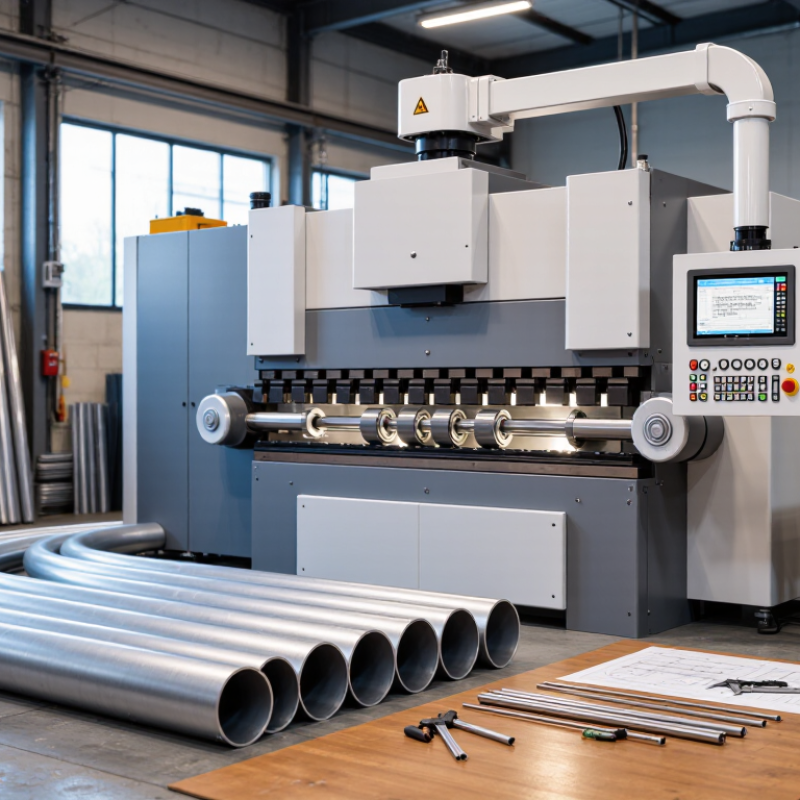
2026 Best Aluminum Pipe Bending Machine for Sale

What Is an Aluminum Pipe Bending Machine?

An aluminum pipe bending machine shapes aluminum pipe or tubing into a planned curve without cutting it. It uses a motor, hydraulic system, or manual force to move the workpiece against a die. The die sets the bend radius, while clamps help hold the material steady. The aim is a smooth curve with minimal flattening, wrinkling, or surface damage.

Different machines suit different jobs. A rotary-draw bender pulls the pipe around a fixed form and can produce repeatable bends. A roll bender passes material through several rollers to create broad curves. Tight bends may need an internal mandrel to support the pipe wall. Not every setup needs one; wall thickness and bend radius matter.

Aluminum is relatively easy to form, but it can crease or spring back after bending. Operators should account for the alloy, temper, pipe diameter, and wall thickness. A short test bend helps reveal whether the angle or tooling needs adjustment. Small details matter. There is no perfect setup on paper; material batches can behave differently, so checking sample parts remains worthwhile. A machine’s capacity should match the actual pipe dimensions, not just the advertised maximum.

How Aluminum Pipe Bending Machines Work

2026 Best Aluminum Pipe Bending Machine for Sale

How Aluminum Pipe Bending Machines Work

An aluminum pipe bending machine shapes a tube by pressing it around a die, which sets the bend’s radius and angle. Clamps hold the pipe in position while the bending arm moves it steadily around the die. On some machines, a mandrel sits inside the tube to help prevent the walls from collapsing during a tight bend. Simple setup matters.

Before bending, an operator enters or sets the desired angle, then checks that the pipe diameter and wall thickness match the tooling. CNC models control movement electronically; manual machines rely more on operator adjustment. Either way, aluminum can spring back slightly after pressure is released. The final angle may differ from the setting.

A small test bend helps reveal how much springback to expect. Operators can then adjust the bend angle or setup and inspect the tube for wrinkles, flattening, or surface marks. Alloy, temper, and bend radius all affect the result, so one setting will not suit every job. In practice, the first setup may need another adjustment. That part is easy to underestimate.

Types and Key Features of Bending Machines

Aluminum pipe benders fall into several practical types. Rotary-draw machines suit repeatable elbows and tight radii, while roll benders form broad, gradual curves. Compression models are simpler, but can flatten thin-wall tube more easily. CNC rotary-draw systems add programmable bends for complex parts and repeat production runs. The choice depends on tube diameter, wall thickness, alloy, and required bend radius.

Key features matter more than a long list of options. A mandrel and wiper die help control wrinkling and cross-section collapse; servo axes and bend compensation improve repeatability. Check the machine’s diameter range, tooling changeover time, and ability to correct aluminum springback. A perfect bend on one sample proves little. Test the actual alloy and wall thickness. Even experienced operators can underestimate springback.

Market context supports careful equipment selection. Grand View Research estimated the global metal fabrication equipment market at USD 68.36 billion in 2023, with a projected 4.9% compound annual growth rate from 2024 to 2030. The International Energy Agency reported nearly 14 million electric cars sold worldwide in 2023, about 18% of car sales. These figures do not measure pipe-bender demand directly, but they show why flexible fabrication matters across changing applications. A machine that handles several profiles may be more useful than one optimized for a single part. A little caution pays.

2026 Best Aluminum Pipe Bending Machines for Sale — Types & Key Features

Standard pipe outside diameters provide a useful starting point when comparing bending machine capacity.

The chart shows standard NPS outside diameters, not a machine’s bending capacity. Actual capacity depends on the machine, tooling, material temper, wall thickness, and bend radius.

Machine types: Manual benders suit light-duty work; rotary-draw machines offer controlled, repeatable bends; mandrel benders help limit wrinkling and collapse on tighter bends; CNC benders support automated, repeat production.

How to Choose a Machine for Aluminum Pipe Projects

Choosing an aluminum pipe bending machine starts with the parts you actually make. Record the tube’s outside diameter, wall thickness, alloy, and temper. A thin-wall tube may wrinkle or flatten under pressure, while a tight bend can crack harder material. Small details matter. Check the minimum centerline radius your drawings require, not just the machine’s maximum capacity.

Match the bending method to your workload. Rotary-draw machines suit repeatable bends and tighter radii, especially when matched with the correct die set and mandrel. Roll benders are more practical for broad curves and long sections. Ask whether tooling is available for your exact tube size. A machine may list a generous capacity, but that does not guarantee clean bends across every alloy and wall thickness. This is where a spec sheet can mislead.

Before buying, request a sample bend using material close to your project stock. Inspect the tube for wrinkles, cracks, and excessive ovality, then compare the bend angle with your drawing. Check how quickly operators can change tooling and adjust settings. Controls should be repeatable, but a complicated interface can slow a small workshop. I would also leave room in the budget for trial pieces; aluminum sometimes behaves differently than expected, and that learning curve is easy to underestimate.

2026 Best Aluminum Pipe Bending Machine for Sale - How to Choose a Machine for Aluminum Pipe Projects

Project type Example tube and bend requirements Machine configuration to consider Key specifications to check Practical selection check
Furniture and light frames Example envelope: 12–38 mm outside diameter, 1–2 mm wall, with bends around 2–3 times the tube diameter. Rotary-draw bender; consider a mandrel for tight bends or thin-walled tube. Maximum tube diameter and wall thickness; supported bend radius; die availability; clamping and mandrel options. Test the actual alloy, temper, tube size, and bend radius. Inspect for wrinkles, flattening, and surface marks.
Handrails and architectural tubing Example envelope: 25–60 mm outside diameter, 1.5–3 mm wall, with repeatable bends across multiple parts. CNC rotary-draw bender for repeatable angles; mandrel support may be needed for tighter radii. Bend-angle control; repeatability; tooling changeover time; workpiece support; program storage. Confirm the machine can hold the required angle and part dimensions over a production run, not just on one sample.
Large-radius curves and long sections Example envelope: 25–76 mm outside diameter, with a centerline bend radius of approximately 5 times the tube diameter or larger. Three-roll or profile roll bender, selected for the required tube profile and curve radius. Roll capacity; minimum achievable radius; adjustment method; straight-end length; support for the tube profile. Ask for a trial curve at the required radius. Check springback and whether the straight sections at each end are acceptable.
Prototypes and mixed-size jobs A varied mix of tube diameters, wall thicknesses, bend radii, and part geometries. Programmable CNC rotary-draw machine with tooling suited to the most demanding part in the range. Supported tool sets; setup flexibility; control interface; program editing; changeover and calibration procedures. Compare setup time and tooling cost across the full job mix, rather than choosing solely by maximum capacity.
High-volume, multi-bend components Repeated parts with several bends, fixed bend sequences, and consistent end-to-end dimensions. CNC rotary-draw machine; evaluate automatic feeding or unloading when cycle time justifies it. Axis count; bend sequence capability; cycle time; part handling; safety features; service and maintenance requirements. Run a timed production trial using the target part and batch size. Include loading, unloading, inspection, and tool changes.

Note: Tube dimensions and bend ranges above are example project-planning envelopes, not guaranteed machine limits. Actual capability depends on the machine, tooling, aluminum alloy and temper, tube geometry, and required bend quality. Verify capacity with a sample bend using the intended material.

What to Check Before Buying a Bending Machine in 2026

2026 Best Aluminum Pipe Bending Machine for Sale

What to Check Before Buying a Bending Machine in 2026

Choosing a pipe bender starts with the parts you actually make. Check the aluminum alloy, tube diameter, wall thickness, and required bend radius. A machine rated for one tube size may struggle with thinner walls or tighter bends. Ask for its working capacity across your full range, not just its maximum. Small details matter. Confirm whether the quoted setup includes suitable dies and mandrels for your profiles.

Tips: Take a sample tube to the supplier and request a test bend. Inspect the bend for wrinkles, flattening, and cracks. Measure the finished angle and ovality. A glossy demonstration is not enough; repeat the test with your own material and dimensions.

Compare control options, changeover time, and bend repeatability for the jobs you run most often. Ask how operators save and adjust programs, and whether the controls show clear error messages. Check machine footprint, power requirements, guarding, and access to routine maintenance points. Get details on installation, operator training, spare parts, and service response times in writing. A lower purchase price can be tempting, but downtime has a cost too. I would not rely on a single sales claim; some details may still need verification during a production trial.