Top 10 Benefits of Automatic Die Welding for Manufacturers?
The manufacturing industry has witnessed significant advancements, with Automatic Die Welding emerging as a pivotal technology. This process enhances production efficiency and ensures higher quality products. By automating the welding process, manufacturers can achieve consistent results that manual methods often cannot replicate.
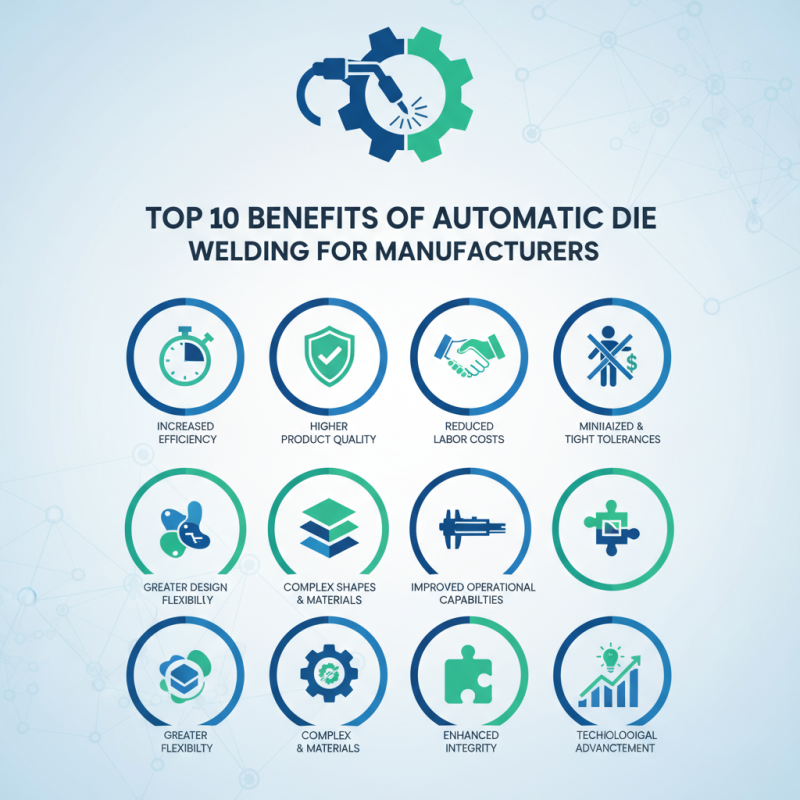
Automatic Die Welding leads to reduced labor costs and minimized human error. The precision offered by this technique is crucial for industries requiring tight tolerances. Moreover, it allows for greater flexibility in design, accommodating complex shapes and materials. The technology has proven to be a game changer for manufacturers seeking to improve their operational capabilities while maintaining product integrity.
However, while Automatic Die Welding offers numerous benefits, it also presents challenges. Implementing such technology requires careful planning and investment. Additionally, ongoing maintenance and the need for skilled personnel must be considered. As manufacturers embrace these innovations, continuous evaluation is essential to address potential shortcomings and optimize performance.
Key Features of Automatic Die Welding Technology
Automatic die welding technology has transformed the manufacturing landscape. This process offers precision and efficiency, making it an attractive option for many manufacturers. Key features of this technology include enhanced speed and repeatability in welding processes. These benefits allow for high productivity without sacrificing quality.
One notable aspect is the adaptability of automatic die welding systems. They can process various materials, which is essential in today's diverse manufacturing environment. However, implementing this technology requires skilled personnel who understand the nuances of the machines. Over-reliance on automation can lead to challenges if operators lack adequate training.
Moreover, automatic die welding systems often have built-in safety features. These include sensors and emergency shut-off mechanisms that prevent accidents. Nonetheless, manufacturers must regularly maintain and calibrate the equipment to ensure optimal performance. This necessity for ongoing attention reflects the complexity inherent in these advanced systems.
Top 10 Benefits of Automatic Die Welding for Manufacturers
| Benefit | Description | Impact on Manufacturing |
| Increased Efficiency | Automatic die welding significantly speeds up the welding process. | Reduces production time and operational costs. |
| Consistency & Quality | Ensures uniformity in weld strength and appearance. | Improves product reliability and reduces defects. |
| Safety | Reduces operator exposure to hazardous welding processes. | Enhances workplace safety and compliance. |
| Cost Savings | Lowers labor costs and reduces material waste. | Increases overall profitability. |
| Flexibility | Easily adapts to various materials and designs. | Expands manufacturing capabilities. |
| Scalability | Can be scaled up for large production runs. | Facilitates growth and demand management. |
| Precision | Achieves high accuracy in weld placement. | Meets stringent industry standards. |
| Reduction of Human Error | Minimizes errors caused by manual operation. | Enhances overall quality control. |
| Data Integration | Allows for easy integration with manufacturing data systems. | Improves tracking and reporting capabilities. |
| Environmental Impact | Reduces energy consumption and material waste. | Supports sustainability initiatives. |
Enhanced Precision and Quality in Welding Processes
Automatic die welding has revolutionized manufacturing, particularly in enhancing precision and quality. According to a recent industry report, companies adopting automatic die welding systems report improvements in weld quality by up to 30%. This advancement reduces errors and defects, ensuring that each weld meets stringent specifications consistently.
Tips: Regular calibration of welding machines can further optimize performance. Ensure operators receive proper training to maximize the technology's benefits.
Another critical advantage of automatic die welding is its ability to minimize human error. Manual welding often leads to inconsistencies. Automated systems utilize advanced algorithms that ensure uniformity, which is crucial for high-volume production. A study indicates that manufacturers can reduce rework costs by up to 25% with more precise welding processes.
Tips: Monitor the welding environment to control variables like temperature and humidity. Regular maintenance of equipment ensures reliability and quality.
Embracing automatic die welding not only enhances precision but also boosts overall productivity. By focusing on quality improvements, manufacturers can achieve better client satisfaction and higher retention rates.
Increased Production Efficiency and Output Rates
Automatic die welding offers immense benefits for manufacturers, especially in efficiency and output rates. According to a recent industry report, automation can increase production efficiency by up to 30%. This surge is attributed to the reduction of manual labor, which often introduces delays. By leveraging automatic die welding technology, firms can ramp up their production without sacrificing quality.
The ability to operate continuously is another advantage. Many automated systems can function around the clock, leading to substantial gains in output rates. A study by the Manufacturing Institute found that companies utilizing automated welding saw a 25% increase in their production output. However, transitioning to automation requires careful planning. Manufacturers must ensure their workforce is trained adequately. Neglecting this aspect can lead to inefficiencies or hiccups in production.
Moreover, while automatic die welding streamlines many processes, it can create challenges. Equipment maintenance becomes crucial. A machine failure can halt an entire production line. Additionally, reliance on automation may lead to skill degradation among workers over time. Balancing automation with human skill is essential for long-term success.
Cost-Effectiveness and Reduction of Material Waste
Automatic die welding offers significant cost-effectiveness for manufacturers, especially in reducing material waste. By automating the welding process, manufacturers can maximize efficiency. This technology uses precisely controlled parameters, minimizing excess material. As a result, manufacturers save money on raw materials and reduce production costs.
Moreover, automatic die welding leads to less scrap material. Much of the waste produced in traditional welding processes disappears. This reduction not only cuts costs but also supports sustainability goals. Companies often face challenges in managing excess waste, which contributes to higher disposal costs. With automatic methods, these challenges decrease.
However, transitioning to automatic die welding is not without its challenges. Initial investment costs can be high. Manufacturers must consider long-term benefits versus short-term expenses. Training for staff to operate new machinery also requires time and resources. Each manufacturer must weigh these factors carefully. Ultimately, those who embrace this technology may find it transforms their operational efficiency.
Top 10 Benefits of Automatic Die Welding for Manufacturers
Safety Improvements in Manufacturing Environments
Automatic die welding presents numerous safety improvements for manufacturers. This method reduces the risk of human error during welding operations. Machines perform repetitive tasks, minimizing exposure to hazardous conditions. Ensuring consistency is vital; it leads to fewer accidents and greater reliability in products.
Work environments become safer when automatic systems are in place. Operators can monitor machines from a distance, allowing them to maintain safety while focused on quality control. This distance reduces potential injury risks associated with handling heavy materials. Workers feel more secure, leading to increased morale and productivity.
Tips: Regularly inspect automatic die welding machines to ensure they function correctly. Conduct employee training on safety protocols related to automated systems. Continuous monitoring can help identify potential issues early, promoting a safer workplace. Engaging employees in safety discussions can foster a proactive safety culture.