China Top 10 Ultrapure Water Purification System Suppliers

An ultrapure water purification system is not simply a set of filters. It is a carefully monitored process that removes ions, particles, organics, and microbes to protect sensitive manufacturing steps. In a semiconductor plant, even a small change in resistivity or particle count can disrupt production. The details matter.

Grand View Research estimated the global ultrapure water market at about US$7.2 billion in 2023 and projected continued growth through 2030. Such forecasts depend on market definitions, so they should be treated as estimates, not guarantees. SEMI’s International Roadmap for Devices and Systems also describes increasingly demanding requirements for semiconductor manufacturing, including contamination control. These references help explain why buyers compare system design, monitoring, service capability, and operating costs—not price alone.

Membrane researcher Mark A. Shannon’s work on water treatment supports a useful engineering principle: design around the contaminants that must be removed, not around equipment labels. This is a paraphrase, not a verbatim quotation. There is no universal system recipe. Feed-water quality, target purity, and plant layout all change the answer. For buyers evaluating China’s top suppliers, this guide examines technical scope, quality controls, project experience, and after-sales support. A polished brochure is not proof. Ask for test data. Then check how the supplier handles real operating conditions.
China Top 10 Ultrapure Water Purification System Suppliers

Definition and Scope of Ultrapure Water Purification Systems

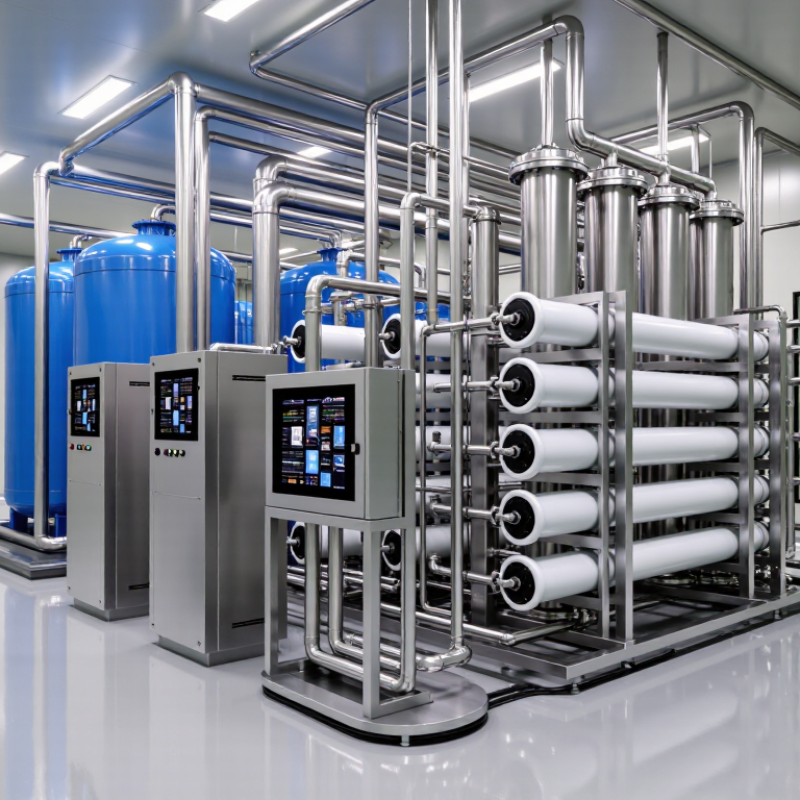
Ultrapure water purification systems are integrated treatment lines designed to remove ions, organic compounds, particles, microorganisms, and dissolved gases. They are more than high-grade filters. A typical system may combine pretreatment, reverse osmosis, electrodeionization, ultraviolet oxidation, and final ultrafiltration. The exact sequence depends on incoming water and process needs. Sensors track measures such as resistivity, total organic carbon, and particle counts. At 25°C, 18.2 megohm-centimeters is a widely used resistivity reference, but it does not describe every quality requirement. There is no single recipe.

In comparing suppliers in China, define scope beyond the purification unit itself. It may include feed-water testing, skid design, storage tanks, hygienic piping, instruments, installation, commissioning, and ongoing maintenance. Semiconductor wafer rinsing, laboratory analysis, and pharmaceutical processes can require different controls and monitoring points. Small details matter: a sample valve, stagnant pipe section, or overdue filter can affect readings. A polished specification can still mislead if it omits operating conditions. That deserves scrutiny. Check how performance is verified, how often sensors are calibrated, and what service is available after handover.

How China’s Ultrapure Water Supplier Market Is Evaluated

Evaluating China’s ultrapure-water suppliers starts with required outlet quality, not a catalogue headline. A semiconductor rinse line, laboratory analyzer, and pharmaceutical process may need different controls. Specify resistivity, total organic carbon, particle limits, flow rate, and recovery expectations before comparing proposals. Small details matter. Ask suppliers to state test conditions and explain how feed-water variation affects quoted performance.

A credible review checks engineering evidence. Look for a process diagram, instrument list, alarm logic, materials data, and commissioning plan. Request recent performance records from comparable installations, with customer details removed. Confirm who handles installation, calibration, consumables, and remote troubleshooting in China. Response time matters. A low price can hide short warranties, costly replacement cartridges, or unclear responsibility when readings drift.

Site visits and technical interviews can reveal whether the team understands daily operation, not just equipment assembly. Ask how operators verify sensors, sanitize loops, and investigate sudden TOC spikes. Check documentation quality and whether training is practical. Compare lifecycle cost with purchase price. No checklist is perfect; water quality changes, and a polished proposal can still miss an awkward plant constraint. Leave room for a pilot or acceptance test.

Profiles of 10 Leading Ultrapure Water System Suppliers in China

These ten supplier profiles highlight different strengths found in China’s ultrapure water sector; they are not a verified ranking. Profile 1 focuses on compact laboratory systems, with clear layouts and straightforward cartridge changes. Profile 2 serves universities and research centers, where variable daily demand matters. Profile 3 designs larger installations for continuous production. Profile 4 emphasizes pretreatment, including sediment filtration and water softening. Small details count.

Profile 5 integrates reverse osmosis with polishing stages and online conductivity monitoring. Profile 6 offers modular equipment that can fit tight plant rooms. Profile 7 specializes in installation and commissioning support. Profile 8 puts more emphasis on routine maintenance, spare parts, and operator training. Profile 9 adapts system designs to incoming water quality, which can vary by location. Profile 10 provides control and alarm features for tracking operating conditions.

Buyers should compare more than advertised purity figures. Ask for test methods, feed-water assumptions, flow-rate data, and service response terms. Request a site-specific process diagram, too. A polished brochure is not evidence of stable output. Supplier claims deserve careful checking, and even a well-designed system may need adjustment after installation. These profiles offer a starting point, not a substitute for technical review.

China Top 10 Ultrapure Water Purification System Suppliers - Profiles of 10 Leading Ultrapure Water System Suppliers in China

The entries below are anonymous supplier capability profiles, not verified company rankings or named-company claims. Actual equipment, performance, certifications, and project references vary by supplier and should be confirmed directly.

Profile Typical System Configuration Common Application Key Selection and Verification Points
1. Industrial RO–EDI System Integrator Pretreatment, reverse osmosis (RO), electrodeionization (EDI), and final polishing as required. Boiler makeup, power generation, and general industrial process water. Review feed-water limits, product-water specifications, recovery, and operating conditions. EDI performance depends on suitable feed-water quality.
2. Semiconductor Water-System Specialist Multi-stage RO, ion-exchange or EDI treatment, UV treatment, ultrafiltration, and point-of-use distribution where specified. Semiconductor manufacturing and other electronics processes requiring high-purity water. Confirm project-specific resistivity, total organic carbon (TOC), particle, microbial, and sampling requirements; specifications depend on the process and system design.
3. Laboratory Ultrapure-Water Supplier Feed-water pretreatment with purification and point-of-use dispensing; configurations vary with incoming water and intended use. Research laboratories, analytical instruments, and laboratory preparation work. Match the water grade to the analytical method or instrument. Check consumable replacement intervals, monitoring, and the stated measurement conditions.
4. Pharmaceutical Water-System Integrator Purification and storage/distribution equipment designed around the applicable pharmaceutical water specification and project requirements. Pharmaceutical manufacturing and related regulated facilities. Confirm the required water type, applicable regulations, hygienic design, qualification documentation, and sampling plan. Ultrapure water is not automatically equivalent to a regulated pharmaceutical water grade.
5. Electronics and Display-Process System Builder RO-based treatment with deionization, UV, filtration, and distribution stages selected for the process. Display-panel, precision-cleaning, and electronics production processes. Specify point-of-use quality and flow requirements. Confirm materials, flushing procedures, monitoring points, and compatibility with the production process.
6. Modular Skid-System Manufacturer Factory-assembled treatment skids combining selected pretreatment, RO, EDI, pumps, instruments, and controls. Projects with limited installation space or a need for modular expansion. Check skid dimensions, utility connections, maintenance access, control-system interfaces, and the scope of factory and site acceptance testing.
7. High-Recovery RO System Provider RO treatment configured with feed conditioning and, where suitable, staged or recirculating arrangements. Industrial sites seeking to manage feed-water use and concentrate volumes. Request a design basis covering feed-water analysis, recovery, scaling control, concentrate handling, and expected membrane operating conditions.
8. UV and TOC-Control System Provider UV units integrated with upstream and downstream purification stages; UV wavelength and placement depend on the design objective. Systems requiring microbial control or reduction of organic carbon. UV at 254 nm is commonly used for disinfection, while 185 nm UV can support organic-carbon oxidation in suitable systems. Verify lamp specifications and performance testing.
9. Ultrafilter and Final-Polishing Integrator Ultrafiltration and/or final polishing installed downstream of primary purification as required by the water-quality target. Applications requiring additional control of particles or selected high-molecular-weight contaminants. Ultrafiltration is a membrane separation step and does not by itself remove dissolved ions. Confirm membrane rating, integrity-testing method, and system placement.
10. Engineering, Commissioning, and Service Provider Project engineering, equipment integration, installation support, commissioning, operator training, and ongoing maintenance. New installations, system upgrades, and facilities needing local technical support. Verify the service scope, response arrangements, spare-parts availability, documentation, training, and acceptance criteria before contract award.

Key Technologies and Industries Served by These Suppliers

Ultrapure-water systems rely on several treatment stages working together. Reverse osmosis removes most dissolved salts, while electrodeionization polishes the water without routine chemical regeneration. Ultraviolet oxidation targets trace organics; ultrafiltration captures fine particles before water reaches sensitive processes. At 25°C, water’s theoretical resistivity limit is about 18.2 MΩ·cm, but real plants must also monitor particles, total organic carbon, and microbial growth. Small details matter.

Semiconductor fabrication is a major application, alongside pharmaceutical production, power generation, photovoltaic manufacturing, and analytical laboratories. The Semiconductor Industry Association reported global chip sales of $627.6 billion in 2024, up 19.1% from 2023. That figure signals a large production ecosystem, not guaranteed demand for every purification supplier. System design still depends on local feedwater, required purity, plant size, and the cost of continuous recirculation.

Supplier evaluations should examine sensor placement, alarm response, sanitization procedures, and maintenance access—not just headline purity claims. ASTM D5127 provides guidance for ultrapure water used in electronics and semiconductor processing. Yet specifications alone can miss practical weaknesses: a clean sample at the central loop may not reflect water quality at a distant point of use. This is easy to overlook. Companies comparing suppliers should request operating data and confirm how performance is measured over time.

Factors to Consider When Selecting a Chinese Supplier

Selecting a Chinese ultrapure water system supplier starts with the water, not the catalogue. Share your feed-water analysis, required resistivity, flow rate, and daily operating hours. Ask for a process proposal showing pretreatment, reverse osmosis, polishing, storage, and monitoring points. Details matter. An impressive outlet-water figure means little if it was measured under conditions unlike yours.

Check how the supplier verifies performance. Request recent test records, calibration details, and acceptance criteria for resistivity, total organic carbon, and microbial control. Clarify which measurements are continuous and which require laboratory sampling. Ask to see a maintenance schedule, consumables list, and alarm-response procedure. If possible, speak with operators at a comparable installation or arrange a technical site visit. Paperwork can look complete. Still, the person answering your process questions should understand the system beyond its sales sheet.

Compare engineering support as carefully as equipment price. Confirm drawing turnaround, commissioning scope, spare-part availability, and response times across your working hours. Discuss training for routine tasks, such as replacing cartridges or checking a conductivity sensor. Have key requirements written into the quotation and acceptance plan. One point is easy to miss: a lower-cost design may need more frequent cleaning or skilled attention. That trade-off deserves a realistic operating estimate, even when early estimates are imperfect.