

China Top High Speed Pick and Place Robot Manufacturers
China has become an important source of automation equipment, including the high speed pick and place robot. These systems move components between conveyors, trays, and packaging stations with tightly timed motions. In electronics plants, a small gripper may place a component onto a moving board. In food production, washdown requirements and product handling can matter just as much as speed.
This guide introduces notable China-based manufacturers and the factors buyers can compare. Look beyond the headline cycle rate. Check payload, repeatability, working range, vision integration, safety features, and support availability. Ask how performance changes with your actual product and line layout. A fast demonstration is useful. It is not the whole test. Manufacturing expert Taiichi Ohno’s reminder, “Where there is no standard, there can be no kaizen,” offers a practical lens for evaluating automation. The quote is not about robots alone, but it points to the value of clear process standards.
Supplier claims still deserve careful review. Request test data, reference installations, and details about spare parts and commissioning. Compare total operating needs, not just purchase price. Some listings make comparison difficult. That is worth acknowledging. A polished product page cannot show every limitation, and this overview cannot replace a factory acceptance test. The following sections aim to help readers ask better questions, distinguish useful specifications from marketing language, and shortlist manufacturers for closer evaluation.
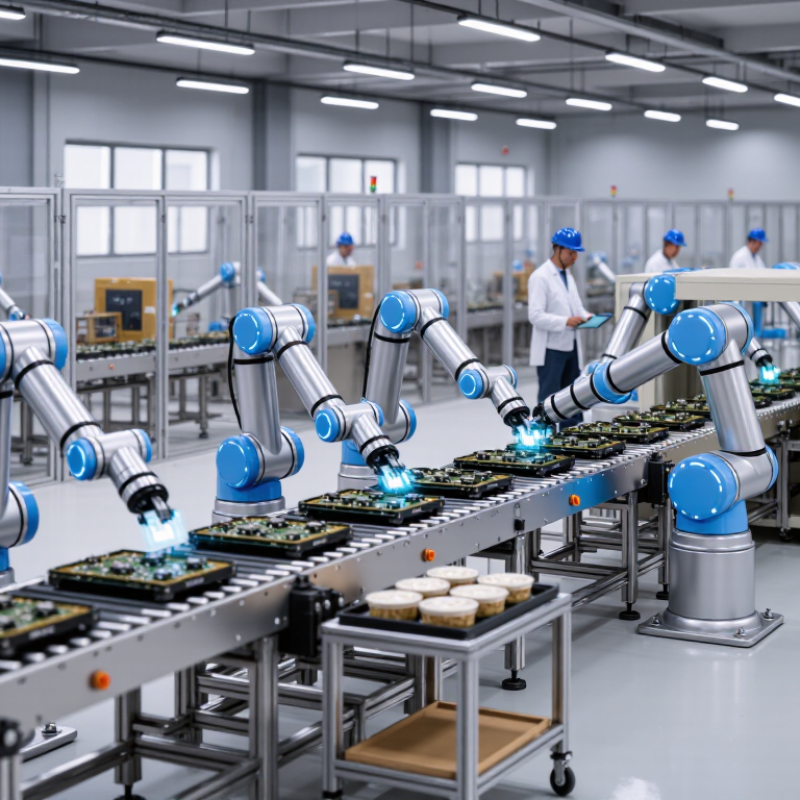
What High-Speed Pick-and-Place Robots Are and How They Work
A high-speed pick-and-place robot transfers parts between defined points with short, repeatable cycle times. Delta robots use lightweight arms arranged around a fixed base, making them suited to rapid handling of small items. SCARA robots offer fast horizontal movement with controlled vertical placement. Both rely on servo motors, motion controllers, and an end effector shaped for the part, such as a vacuum cup gripping a flat carton.
A typical cell pairs the robot with a conveyor, sensors, and often a vision system. Cameras locate moving products; conveyor tracking lets the robot match their motion before picking. The controller then calculates a path that balances speed, reach, payload, and placement accuracy. Small parts. Fast moves. Yet “high-speed” alone can mislead: a heavier gripper or a poorly arranged infeed can slow the real cycle. IFR’s World Robotics 2024 report says China installed 276,288 industrial robots in 2023, about 51% of global installations. That figure signals a large automation market, but it does not measure pick-and-place performance specifically. Buyers should compare tested cycle times under their own product, spacing, and accuracy conditions. A lab figure may not survive production dust, irregular arrivals, or frequent changeovers. That distinction matters.
China Top High Speed Pick and Place Robot Manufacturers - What High-Speed Pick-and-Place Robots Are and How They Work
| Robot Type | How It Moves | Typical Applications | Typical Payload Characteristics | High-Speed Advantages | Key Selection Considerations |
|---|---|---|---|---|---|
| Delta robot | Parallel arms move a lightweight end effector through a three-dimensional work area, commonly with an additional wrist axis for tool rotation. | Food handling, packaging, sorting, and picking small components from a conveyor. | Generally suited to light payloads; permissible load depends on arm length, speed, reach, and tooling. | Low moving mass and parallel kinematics support rapid, repeated pick-and-place movements. | Check usable workspace, payload including the gripper, product spacing, washdown requirements, and conveyor-tracking capability. |
| SCARA robot | Two horizontal rotary joints position the tool in the work plane; a vertical axis provides up-and-down motion. Some models add tool rotation. | Assembly, packaging, machine tending, and transfer of parts between nearby stations. | Available configurations range from small-part handling to heavier assembly tasks; capacity varies by reach and motion profile. | Fast planar movement and a compact footprint suit repetitive transfers over a fixed work area. | Compare reach, vertical stroke, mounting orientation, required repeatability, and the time needed for the full task cycle. |
| Cartesian or gantry robot | Linear axes move the tool along straight paths, typically in X, Y, and Z directions. | Tray loading, palletizing, dispensing, and pick-and-place across a rectangular work area. | Payload capacity can be configured for a wide range of loads, but speed and stiffness depend on span and axis design. | Straight-line motion is easy to plan, and long travel distances can be covered within a structured layout. | Consider installation space, gantry rigidity, axis acceleration, cable routing, and whether the work area is rectangular. |
| Six-axis articulated robot | Six rotary joints allow the arm and tool to approach a part from many directions. | Machine tending, packing, assembly, and handling parts with changing orientations. | Payload and reach vary widely across configurations; tooling and workpiece inertia must be included in the load calculation. | Flexible approach angles can reduce the need for complex part fixtures or multiple handling stations. | Evaluate reach, wrist load, collision risk, path complexity, and cycle time for the actual programmed motion. |
| Vision-guided pick-and-place system | A camera identifies part position and orientation; the controller transforms image coordinates into robot coordinates before the pick. | Randomly oriented parts, moving conveyors, sorting, and mixed-product handling. | Payload is determined by the selected robot and end effector, rather than by the vision system alone. | Can handle variable part locations without requiring every item to be precisely fixtured. | Account for lighting, camera field of view, image-processing time, calibration, part overlap, and conveyor speed. |
| Vacuum pick-and-place tool | A vacuum generator and suction cups grip suitable surfaces; the robot releases the part by venting or switching off vacuum. | Cartons, sheets, trays, and products with relatively smooth, non-porous surfaces. | Grip capacity depends on cup size, vacuum level, surface condition, leakage, and acceleration. | Simple tooling can pick and release compatible products quickly with few moving parts. | Verify surface porosity, product deformation risk, cup placement, vacuum monitoring, and safe handling during power or air loss. |
| Mechanical gripper pick-and-place tool | Fingers close around the part using pneumatic, electric, or other actuation, then open to release it. | Rigid components, parts with accessible edges, and items that are unsuitable for vacuum pickup. | Grip force and allowable part size depend on finger geometry, actuator capacity, and the workpiece material. | Provides a positive grip when the part shape offers reliable contact surfaces. | Check finger clearance, grip force, part variation, marking risk, and whether the gripper can confirm a successful pick. |
| Typical pick-and-place sequence | Locate the part, move to the pick point, engage the gripper, verify pickup, travel to the destination, release, and return or move to the next part. | Automated transfer between conveyors, fixtures, packaging lines, and production machines. | The complete payload includes the workpiece, gripper, adapters, and any carried components. | Cycle time can be improved by minimizing travel distance, unnecessary rotation, settling time, and idle conveyor time. | Assess the complete operation, including sensing, gripping, safety pauses, product variability, and upstream or downstream line speed. |
Note: Performance is application-specific. Actual payload, reach, repeatability, and cycle time should be confirmed using the robot configuration, end effector, workpiece, motion profile, and operating conditions required for the task.