Essential Tips for Choosing a Regulated Power Supply?
Choosing a Regulated Power Supply is crucial for any electronic project. Dr. Emily Tran, a leading expert in power electronics, once stated, "The right power supply can enhance performance and reliability." Understanding this can help users avoid common pitfalls.
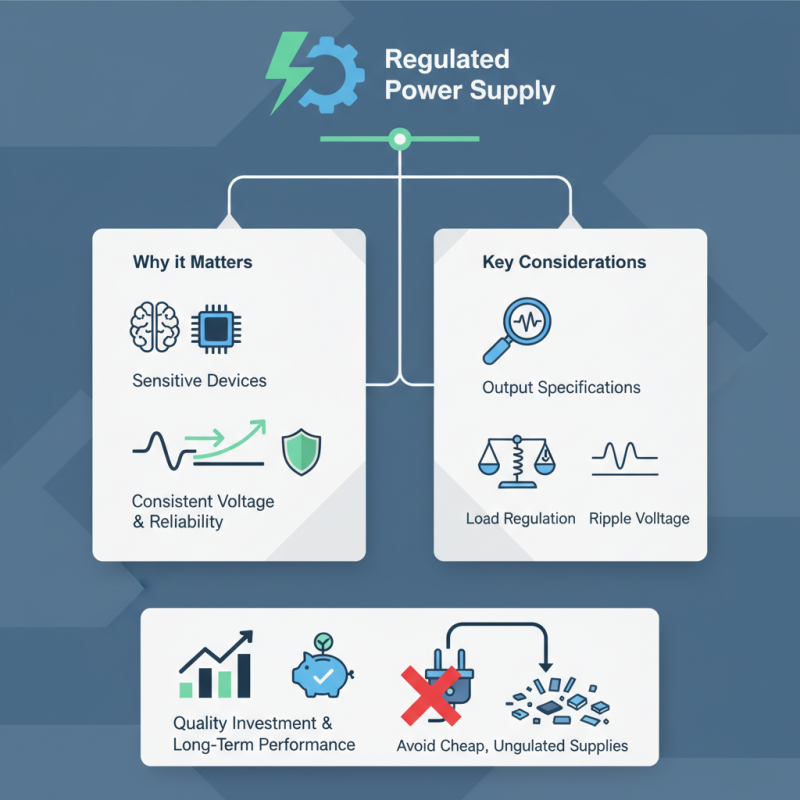
A regulated power supply ensures consistent voltage and current. This stability is vital for sensitive devices like microcontrollers. An unstable power supply can lead to device failures or data loss. It's important to evaluate the output specifications carefully. Users often overlook critical factors like load regulation and ripple voltage.
Many buyers rush their decision, focusing only on price. However, a cheap, unregulated power supply can damage equipment. Do thorough research and consider long-term effects. Users should think about how a poor choice can impact their projects. A reliable regulated power supply is an investment in quality and performance.
Understanding Regulated Power Supplies: Types and Applications
Regulated power supplies come in various types. Each has unique features suited for different applications. Linear power supplies are known for their stability and low noise. They suit sensitive equipment well. However, they can be bulky and less efficient than other options.
Switching power supplies offer compact designs. They are more efficient but may introduce some noise. These supplies are widely used in consumer electronics. They handle different voltage levels and load variations easily. When choosing a type, consider your application's specific needs.
Look for adjustable output voltages. Some devices require precise voltage control. Others may be tolerant of variations. Understanding the load requirements is crucial. Insufficient power can lead to device failure. Conversely, excessive power can damage components. Evaluate the environments too. If noise is an issue, opt for linear supplies despite their size.
Key Specifications to Consider When Selecting a Power Supply Unit
When selecting a regulated power supply, several key specifications must be considered. Voltage output is critical. You must know the required voltages for your devices. Excess voltage can damage sensitive electronics. Conversely, too low of a voltage may lead to insufficient operation. Pay attention to the voltage range. This aspect ensures compatibility with various applications.
Current capacity is another essential specification. Determine the total current your devices will draw combined. A power supply should offer slightly more than this combined current. If the unit is rated too low, it may overheat or fail. Physical size matters too. Ensure that the power supply fits your workspace. A compact design can free up space for other components.
Regulation type impacts performance. Linear power supplies provide smooth, clean power. They are usually quieter but less efficient. Switching power supplies, on the other hand, are more compact and efficient. However, they may introduce noise. Check the efficiency rating as well. Higher efficiency means less energy wasted as heat. Consider all these factors to find the best fit. Sometimes, what seems ideal might lead to unexpected issues.
Essential Tips for Choosing a Regulated Power Supply
This chart represents the key specifications to consider when selecting a power supply unit, showcasing the importance of voltage regulation, current capacity, efficiency, and ripple voltage.
Regulations and Standards for Power Supply Safety and Quality Assurance
When selecting a regulated power supply, safety and quality assurance are paramount. Various international standards guide manufacturers in producing reliable products. For example, the International Electrotechnical Commission (IEC) sets rigorous safety standards. These standards encompass electric shock protection and thermal management. Over 70% of power supply failures stem from inadequate safety compliance.
Understanding these regulations is crucial. A study from the Power Supply Manufacturers Association indicates that compliance with safety standards can reduce the risk of failure by 30%. Yet, some manufacturers cut corners, leading to subpar products. This negligence can result in overheating issues or voltage fluctuations, posing serious risks.
The importance of certifications cannot be overstated. Products meeting ISO 9001 and UL standards often exhibit superior reliability. However, not all products flaunt their certifications clearly. Consumers must research and ensure compliance. Noticing the absence of certifications can signal potential quality concerns. This lack of clarity could lead to avoidable mistakes.
Evaluating Efficiency Ratings and Performance Metrics in Power Supplies
When evaluating power supplies, efficiency ratings are critical. Efficiency percentage indicates how well a power supply converts AC to DC with less waste. The Energy Star program reports that a typical low-efficiency power supply operates at just 70% efficiency. This means 30% of input energy is lost as heat. Choosing a power supply with an 80% efficiency or higher can significantly reduce operational costs.
Performance metrics are also vital to consider. Look for specifications like load regulation, ripple voltage, and temperature coefficient. According to industry studies, robust load regulation ensures voltage consistency under varying loads. Ripple voltage, measured in millivolts, should ideally be under 100mV for optimal performance. Higher ripple can impair sensitive components, leading to potential failures.
While high efficiency and reliable performance are important, don’t overlook the design. A poorly designed power supply may meet all efficiency and performance standards but still run hot or become unstable. Balancing these factors requires careful consideration. A power supply that excels in one area might falter in another. So, don't rush the selection process.
Common Mistakes to Avoid When Choosing a Regulated Power Supply
When selecting a regulated power supply, many make critical mistakes. One common error is neglecting the load requirements. It's essential to match the voltage and current specifications to the needs of your devices. Research indicates that mismatched power supplies can reduce equipment efficiency by up to 30%. This can lead to overheating or even failure of components.
Another mistake is overlooking the efficiency rating. A power supply with a low efficiency can waste energy and result in higher operational costs. Data from recent industry studies reveal that high-efficiency power supplies can save users 20-50% on energy costs over time. Choosing the right unit not only supports your devices but also contributes to sustainability efforts.
Inadequate thermal management is often ignored. A power supply that runs too hot can shorten its lifespan. Users should ensure that the supply has adequate airflow or cooling features. Remember, a design flaw or subpar thermal performance may not be noticeable at first, but can lead to significant problems down the line. Always consider these factors during your selection process for optimal performance.