

Top 10 PIR Sensor Switch Manufacturers for Global Buyers
The global demand for smarter lighting and energy control is reshaping the building automation market. A Pir Sensor Switch can detect human movement, reduce unnecessary runtime, and improve convenience in offices, warehouses, hotels, and homes. In practical use, it may turn corridor lights on within seconds, then switch them off after an empty period.
The International Energy Agency reports that buildings remain responsible for roughly 30% of global energy demand. Its Energy Efficiency 2023 analysis also highlights building controls as an important pathway for reducing avoidable consumption. The UNEP Global Status Report for Buildings and Construction 2024 further emphasizes the need for efficient building operations as floor space continues to expand. These findings explain why buyers increasingly compare sensor sensitivity, detection range, delay settings, installation methods, and long-term reliability.
Market research from Grand View Research and MarketsandMarkets indicates continued growth in motion-sensing and smart-building technologies. However, market estimates differ because suppliers classify PIR devices, occupancy sensors, and complete control systems differently. That distinction matters. A low-cost switch may look attractive, yet weak detection near doorways can create repeated lighting failures.
This guide reviews ten Pir Sensor Switch manufacturers serving global buyers. It considers product engineering, certifications, manufacturing capacity, customization, warranty support, and documented field experience. Supplier claims still require verification. Datasheets can be incomplete. Therefore, procurement teams should test samples under real conditions, including bright sunlight, cold storage areas, narrow corridors, and uneven ceiling heights. The ranking is informative, not absolute, because the best manufacturer depends on project size, regional compliance, installation environment, and required control functions.
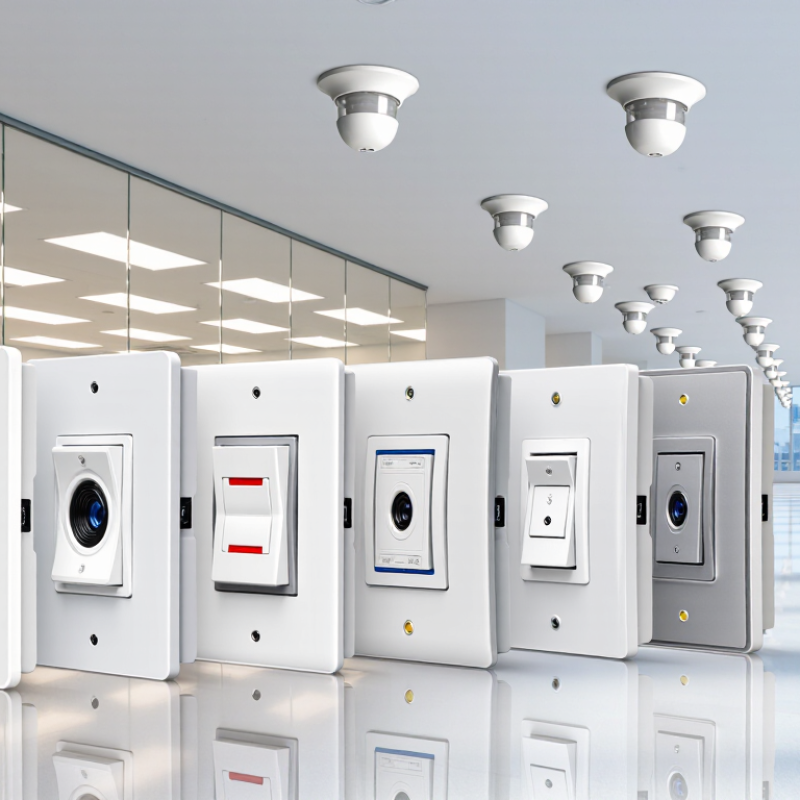
PIR Sensor Switches: Definition, Functions, and Main Applications
A PIR sensor switch detects infrared radiation from moving bodies, usually people, through a pyroelectric element. It does not identify a person. It detects changing heat patterns. When movement crosses its sensing zones, the switch can turn lights, fans, or alarms on automatically.
Its main function is demand-based control. A timer keeps the load active after movement stops, while sensitivity and detection angles shape performance. The U.S. Department of Energy reports that advanced lighting controls can reduce lighting energy use by up to 30% in suitable buildings. The Global Status Report for Buildings and Construction 2023 also states that buildings consume about 30% of global energy. These figures explain the practical value of occupancy-based switching in corridors, offices, toilets, storage rooms, and apartment entrances.
Installation details often decide the result. A ceiling-mounted sensor can cover a broad room, while a wall-mounted unit may detect movement more reliably across a doorway. Direct sunlight, heating vents, glass partitions, and slow movement can create false triggers or missed detection. That limitation matters. In field testing, installers should check the lens height, walking direction, load rating, and delay time under real conditions. A sensor may perform well in an empty showroom but react poorly beside a warm radiator. Buyers should review detection range, standby consumption, ingress protection, wiring method, and operating temperature before selecting switches for global projects.
Top 10 PIR Sensor Switch Manufacturers for Global Buyers - PIR Sensor Switches: Definition, Functions, and Main Applications
The table below summarizes representative PIR sensor switch configurations commonly available in the global market. Specifications vary by product model and should be verified against the manufacturer’s datasheet before purchase.
| No. | Typical PIR Switch Category | Primary Application | Detection Coverage | Typical Detection Range | Adjustable Time Delay | Common Load Rating | Power Supply | Typical Protection | Key Buying Consideration |
|---|---|---|---|---|---|---|---|---|---|
| 1 | Indoor Wall-Mounted PIR Switch | Offices, corridors, classrooms | Wide-angle, approximately 120° | 6–10 m | 10 seconds–30 minutes | Up to 5 A LED or 10 A resistive | 100–240 VAC | Usually IP20 | Neutral-wire requirement and LED compatibility |
| 2 | Ceiling-Mounted PIR Occupancy Sensor | Open-plan offices, retail areas | 360° when centrally installed | 6–12 m diameter | 5 seconds–20 minutes | Typically 3–10 A switching output | 220–240 VAC or low voltage | IP20–IP44 | Mounting height and dead-zone performance |
| 3 | Outdoor PIR Security Switch | Driveways, entrances, gardens | Wide-angle, approximately 120°–180° | 8–15 m | 5 seconds–15 minutes | Up to 10 A resistive load | 100–240 VAC | Commonly IP44–IP55 | Weather resistance, false-trigger control, and temperature range |
| 4 | PIR Light Sensor with Ambient-Light Control | Bathrooms, stairways, utility rooms | Approximately 100°–120° | 5–8 m | 10 seconds–30 minutes | Typically 3–8 A | 100–240 VAC | IP20–IP44 | Lux threshold adjustment and minimum load requirements |
| 5 | Low-Voltage PIR Control Module | LED cabinets, furniture, displays | Approximately 90°–120° | 2–5 m | 5 seconds–10 minutes | Usually 2–5 A DC | 5, 12, or 24 VDC | Typically IP20 | DC polarity, standby current, and connector type |
| 6 | PIR Switch with Manual Override | Hotels, meeting rooms, residential spaces | Approximately 120° | 6–10 m | 10 seconds–30 minutes | Up to 10 A resistive or 5 A LED | 100–240 VAC | Usually IP20 | Override logic, switch wiring, and restart behavior |
| 7 | PIR Sensor Switch with Daylight Harvesting | Energy-efficient commercial lighting | Approximately 120°–360° | 6–12 m | 1–30 minutes | Relay or 0–10 V control output | 100–240 VAC | IP20–IP44 | Control protocol, commissioning method, and lux accuracy |
| 8 | PIR Switch for HVAC Occupancy Control | Offices, classrooms, conference rooms | Approximately 120°–180° | 6–12 m | 5 minutes–30 minutes | Dry contact or low-voltage relay output | 12–24 VDC or mains powered | IP20–IP44 | Relay contact rating and compatibility with HVAC controls |
| 9 | PIR Switch for High-Bay Areas | Warehouses, workshops, sports halls | Approximately 100°–150° | 10–20 m, installation dependent | 10 seconds–30 minutes | 10 A relay or dedicated lighting-control output | 100–240 VAC | Often IP44–IP65 | Mounting height, lens design, ambient temperature, and inrush current |
| 10 | PIR Switch with Wireless Connectivity | Smart homes and connected buildings | Approximately 90°–120° | 5–10 m | Configurable through a controller or application | Battery powered or low-voltage output | Typically 3–24 VDC at sensor side | IP20–IP44 | Wireless protocol, battery life, encryption, and hub compatibility |
Key Criteria for Comparing Global PIR Sensor Switch Manufacturers
Comparing global PIR sensor switch manufacturers requires more than checking price and detection range. A reliable evaluation starts with real operating conditions. Review detection distance, sensing angle, mounting height, standby power, and switching capacity. Ask whether the sensor performs consistently in corridors, bathrooms, warehouses, and offices. Small differences matter.
Request sample units and test them under changing temperatures and lighting levels. Check false triggers near air conditioners, curtains, and moving machinery. Examine response time, adjustable time delays, lux settings, and manual override options. Confirm the enclosure rating for damp locations. A clear test report is useful. Raw measurements are better.
Manufacturer experience appears in practical details. Look for traceable production records, component inspection, calibration procedures, and documented quality controls. Verify relevant safety certifications for the target markets, not just generic claims. Study warranty terms, replacement procedures, firmware control, and technical support response times. Supply continuity also matters; ask about lead times and second-source components. A polished datasheet can still hide weak field performance. I have seen attractive samples fail after repeated relay switching, so endurance testing deserves attention. No comparison is perfect. Leave room for uncertainty. Reliable manufacturers explain limitations instead of promising flawless detection. Reference installations, installer feedback, and transparent corrective-action records can reveal more than marketing language.
Top 10 PIR Sensor Switch Manufacturers and Their Product Strengths
The top 10 PIR sensor switch manufacturers serve different installation needs. Some focus on compact residential switches with adjustable time delays and detection ranges. Others develop commercial units for corridors, offices, and public facilities. Their strongest products usually combine stable motion detection, low standby power, and simple wiring. Good manufacturers also provide clear manuals, responsive technical support, and consistent production quality.
Several leading manufacturers specialize in wide-angle sensing for large rooms. Their switches often include sensitivity controls, daylight thresholds, and relay protection. Industrial-focused suppliers may offer stronger housings, higher load ratings, and better resistance to dust or temperature changes.
For smart buildings, some manufacturers integrate wireless communication, occupancy data, and centralized control. These features can reduce energy waste, but they also increase setup complexity.
Field experience shows that detection accuracy depends on placement, wall materials, airflow, and heat sources. A powerful sensor can still perform poorly when installed near an air conditioner. No manufacturer is perfect. Some products have excellent sensitivity but confusing adjustment controls. Others offer durable hardware but limited after-sales guidance. Buyers should compare test reports, warranty terms, wiring diagrams, and compatibility with local electrical requirements. Small details matter, especially when dozens of switches must operate reliably every day.
How to Evaluate Quality, Compliance, and Technical Support
When comparing the top 10 PIR sensor switch manufacturers, global buyers should examine proof, not polished catalog images. A quality evaluation begins with detection range, response time, standby power, relay life, and false-trigger performance. Request samples and test them in a hallway, warehouse, or humid utility room. Record activation distance at different temperatures. Small differences become obvious. Housing materials should resist yellowing, cracking, and loose terminals. Ask for inspection records, calibration methods, and batch traceability. A supplier that cannot explain its testing process deserves caution.
Compliance requires more than a printed logo on a datasheet. Check whether the exact model has current safety, electromagnetic compatibility, environmental, and regional documentation. Verify certificate numbers with the issuing body when possible. Confirm markings, user instructions, wiring diagrams, and labeling match the shipped product. Also review restricted-material declarations and packaging requirements for your destination. Requirements vary by market. Treat copied certificates as a serious warning. I have seen buyers approve a housing variant, then receive a different internal board. This mistake is expensive and avoidable.
Technical support often separates a reliable manufacturer from a cheap listing. Test response quality before ordering. Send wiring questions, installation photos, and a fault scenario. Strong teams provide clear answers, troubleshooting steps, configuration guidance, and realistic response times. Ask about replacement parts, warranty boundaries, and failure analysis. A useful support contact knows the product limits. That matters. Still, no evaluation is perfect. Sample testing may miss long-term relay wear or installer errors. Build a small pilot order, define acceptance criteria, and keep test records. Do not rely on promises alone.
Selecting the Right PIR Sensor Switch Supplier for Your Project
Selecting the right PIR sensor switch supplier requires more than comparing prices or product photographs. Start with the application, not the catalog. Check detection range, sensing angle, switching load, response time, and operating temperature. A corridor, warehouse, and hotel room need different settings.
Ask suppliers for test reports, material specifications, and sample units. Install samples in the real environment. Bright windows, air vents, moving curtains, and warm machinery can create false triggers. An experienced supplier should explain these risks clearly and suggest practical adjustments. Look for stable quality control, traceable production batches, inspection records, and responsive technical support. Certifications should match your target market and product category, but paperwork alone does not prove field reliability.
Small details matter. Can the supplier provide wiring diagrams and installation guidance? Are replacement parts available? Does the warranty process have clear response times? Ask about minimum order quantities, production capacity, packaging protection, and delivery consistency. A low quote can look convincing. It may hide unstable components or limited after-sales support. I have seen projects delayed because a supplier promised customization without confirming tooling requirements. That mistake is easy to repeat. Request a written specification before approval, including sensitivity, timer settings, load limits, and enclosure protection. Test several units, not only one. One sample can perform perfectly by chance. The right supplier combines verified performance, honest communication, and dependable support throughout the project.