

Why Choose Ceramic Membrane Filtration?
Why choose ceramic membrane filtration when conventional polymeric membranes remain widely available? The answer begins with demanding operating conditions. Ceramic membranes are manufactured from materials such as alumina, zirconia, or titania. They can tolerate higher temperatures, aggressive cleaning chemicals, and continuous industrial use. That matters in wastewater treatment, food processing, biotechnology, and chemical production.
Professor Enrico Drioli, a leading membrane scientist, stated, “Membrane technology is one of the key technologies for sustainable development.” His observation remains relevant to ceramic membrane filtration. A well-designed ceramic module can separate suspended solids, bacteria, oils, or macromolecules while using less floor space than many conventional systems. Imagine a stainless-steel treatment line running beside a hot process tank. The membrane surface faces repeated cleaning cycles, pressure changes, and variable feed quality. Ceramic construction offers practical resilience in that setting.
Still, ceramic membranes are not automatically the best choice. They usually cost more initially. Their channels can foul, especially when pretreatment is weak. Energy consumption may also rise when high crossflow velocities are required. These limitations deserve honest attention. A reliable selection should compare lifecycle cost, feed chemistry, cleaning frequency, recovery targets, and replacement risks. Laboratory results alone can mislead.
The strongest case appears when durability protects production. Operators who record flux decline, pressure trends, and cleaning performance gain better evidence. That experience supports sound engineering decisions. Ceramic membrane filtration is not a universal solution. It is a specialized tool, and its value becomes clearest under harsh, demanding, or long-term operating conditions.
What Is Ceramic Membrane Filtration?
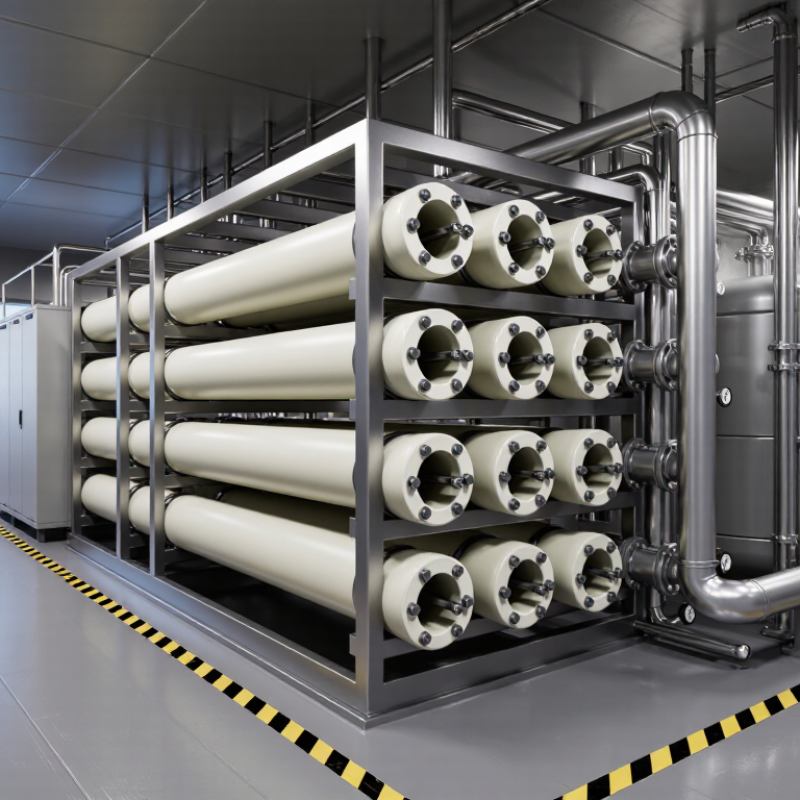
Ceramic membrane filtration is a pressure-driven separation process. It uses a porous inorganic layer, commonly alumina, zirconia, or titania, inside a tubular or flat-sheet support. Feed water moves across the membrane surface. Small pores retain suspended solids, bacteria, and many protozoa, while water and dissolved salts pass through. Microfiltration usually works around 0.1–1 micrometre. Ultrafiltration can reach roughly 0.01 micrometre. Exact performance depends on pore structure, pressure, and fouling.
The US EPA Membrane Filtration Guidance Manual describes microfiltration and ultrafiltration as barriers for particles and microorganisms. It also warns that dissolved chemicals may pass through. That distinction matters at the control panel. Clear permeate does not prove complete treatment. Additional carbon treatment, reverse osmosis, or disinfection may still be required. The World Health Organization’s Guidelines for Drinking-water Quality supports multiple barriers and validated monitoring, rather than visual inspection alone.
Ceramic membranes tolerate heat, oxidation, and aggressive cleaning better than many polymeric membranes. Their rigid surfaces can also support stable flux during oily wastewater treatment. However, they cost more initially and still foul. The UN World Water Development Report 2024 states that agriculture accounts for about 70% of global freshwater withdrawals. This figure adds context, not proof that ceramic filtration fits every facility. Pilot testing remains essential. Measure turbidity, flux decline, cleaning frequency, energy use, and rejected solids. I would not promise maintenance-free operation. Sediment loading can expose a design weakness quickly.
Why Choose Ceramic Membrane Filtration? - What Is Ceramic Membrane Filtration?
| Evaluation Dimension | Typical Ceramic Membrane Data | What It Means in Practice | Why It Can Be Preferred |
|---|---|---|---|
| Definition | A pressure-driven membrane process using porous inorganic materials, commonly alumina, zirconia, titania, or silica. | A feed stream is separated as it passes through pores while retained solids and larger molecules remain in the concentrate. | The inorganic structure provides high mechanical, thermal, and chemical stability. |
| Common separation ranges | Microfiltration: approximately 0.1–10 µm; ultrafiltration: approximately 0.01–0.1 µm. Nanofiltration may use pores below 0.01 µm or dense selective layers. | The selected pore structure determines whether bacteria, suspended solids, colloids, emulsified oil, macromolecules, or some dissolved species are retained. | A single ceramic platform can be configured for different separation duties. |
| Typical transmembrane pressure | Microfiltration and ultrafiltration commonly operate at approximately 0.3–5 bar, depending on module design and feed conditions. | Higher pressure generally increases driving force but may also increase fouling and energy consumption. | Ceramic elements can tolerate pressure cycling and mechanical stress better than many polymeric alternatives. |
| Typical operating temperature | Many ceramic systems can operate well above 100°C when the module, seals, and process design are rated for the temperature; practical systems are often operated below approximately 150–300°C. | Temperature limits are controlled by the complete assembly, especially gaskets, housings, and connections—not only by the ceramic material. | Suitable for hot-process streams and high-temperature cleaning where polymeric membranes may soften or degrade. |
| Chemical compatibility | Generally resistant to a broad range of acids, alkalis, solvents, and oxidizing cleaning agents; the exact limit depends on membrane chemistry and seals. | Cleaning chemicals can often be selected for stronger removal of organic, mineral, or biological foulants. | More aggressive cleaning can help restore permeability and reduce irreversible fouling. |
| Typical permeate flux | Common industrial microfiltration and ultrafiltration values are broadly in the range of 20–300 L/m²·h, but actual flux varies substantially with feed, temperature, pore size, and operating mode. | Flux should be established through pilot testing because clean-water flux does not represent stable process flux. | Stable operation may be maintained over repeated cleaning cycles when the system is correctly designed. |
| Solid and particle handling | Well suited to feeds containing suspended solids, colloids, biomass, pigments, catalysts, and abrasive particles, provided suitable pretreatment and crossflow are applied. | Large particles should still be removed when they could block channels or damage pumps and valves. | High hardness and abrasion resistance can be advantageous in difficult industrial feeds. |
| Cleaning methods | Backwashing, hydraulic flushing, alkaline cleaning, acidic cleaning, enzymatic cleaning, and—when compatible—oxidizing or solvent-based cleaning. | The cleaning sequence should match the foulant type and the chemical limits of the membrane and seals. | Frequent and intensive cleaning is generally more feasible than with many polymeric membrane materials. |
| Expected service life | Ceramic elements can often provide service lives of 10 years or more in suitable applications, although seals, supports, operating conditions, and maintenance strongly affect actual life. | Replacement intervals should be based on permeability, integrity testing, mechanical condition, and total operating cost. | Longer element life can reduce replacement frequency and membrane-related waste. |
| Product recovery | Often capable of producing high recovery in concentration and clarification processes, with recovery determined by viscosity, osmotic effects, solids loading, and fouling control. | Higher recovery reduces liquid waste but can increase concentrate viscosity and fouling risk. | Useful where valuable solids, enzymes, proteins, pigments, or catalysts must be retained and concentrated. |
| Typical applications | Industrial wastewater, oily-water treatment, food and beverage clarification, biotechnology, pharmaceutical processing, catalyst recovery, water reuse, and pretreatment for downstream membranes. | The process can be used for clarification, concentration, solids separation, and removal of suspended or colloidal contaminants. | Broad chemical and thermal resistance supports demanding process environments. |
| Main design limitations | Higher initial capital cost, greater material density, possible brittleness under impact, and potentially higher pumping energy in crossflow operation. | A lifecycle-cost assessment should include energy, cleaning, pretreatment, membrane replacement, downtime, and waste handling. | Ceramic membranes are most attractive when durability, cleanability, temperature resistance, and process stability outweigh the higher upfront cost. |
Note: The values shown are representative engineering ranges for ceramic microfiltration and ultrafiltration systems. Actual performance depends on membrane geometry, pore size, feed composition, temperature, viscosity, crossflow velocity, pretreatment, and cleaning practice.
Related Posts
-
Understanding the Science Behind Ultrapure Water Purification Systems: Breaking Down 99.9999% Purity and Its Applications
-
7 Tips for Choosing a Tangential Flow Filtration System
-

Top 10 Benefits of Hollow Fiber Membrane Filters for Water Purification
-
Why Wood Pulp is Essential for Sustainable Paper Production and Its Impact
-

Innovative Examples of Ultra Pure Water Purification Systems Transforming Industrial Standards
-

How to Optimize Cross Flow Filtration for Maximum Efficiency in Industrial Applications